





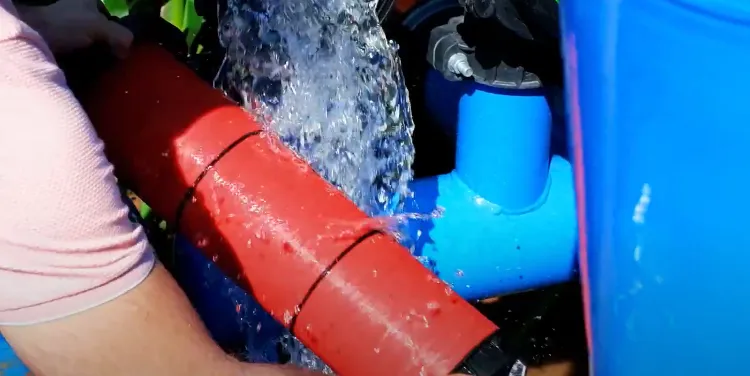
Irrigation filters filter out most of the pollutants that comes from your water source, and most of the gunk that builds up in your pipes between your irrigation system and water source. As a matter of fact, we don’t recommend irrigating without it if you use drip irrigation.
Disc cartridges are effective at removing both particulates, such as sand, and organic matter. Essentially, a disc filter consists of a stack of round discs with minuscule gaps between them when compressed together. As water flows through these spaces, particles are trapped and remain behind, ensuring cleaner water passes through the system.
Screen cartridges are the most common type of filter, and they are excellent for removing hard particles such as sand. However, they are not ideal for filtering out organic materials like algae and slime.
The inner part of the filter. This piece is replaceable in the housing.
Filters with screen cartridges
Screen cartridges are the most common filters and are excellent for removing hard particles such as sand. They are not ideal for removing organic materials such as algae and slime.
Filters with disc cartridges
Disc cartridges are good at removing both particulates, like sand and organic matter. A disc filter consists of a stack of round discs with minuscule spaces between them when stacked together. Water and particles are forced between the spaces between the discs, with particles remaining behind.
Refers to the size of particles that a filter will filter out. If a filter is 5 microns, it can filter out the smallest bacteria particles, but a filter of 130 microns (which we recommend you use), filters out basic debris, sand, dirt, algae, etc. without affecting the flow rate.
The surface available on the cartridge that can catch and retain particles in a layer. This ‘caught’ layer only increases the filtering material available to catch debris.
The source of water, as well as the level of filth in that source, is an important factor to consider. Generally, dams and rivers require a more extensive filter bank than other systems in order to sufficiently filter out pollutants.
Certain types of filters are better suited to specific pollutants; therefore, choose the one that targets the issue you struggle with most.
Solids like manure or dirt can clog water outlets. Therefore, we recommend disc filters for solids.
Sand will clog water outlets and cause wear and tear to the inner walls of the system. Therefore, we recommend screen filters for sand.
Algea will clog water outlets, and grow on the inner walls of the pipe, accumulating debris and creating blockages. Therefore, we recommend disc filters for algea.
General pollutants from a river or dam will cause blockages, and create wear-and-tear and clog outlets. Therefore, we recommend disc filters for debris.
You need to clean your irrigation filter weekly, at regular intervals, and as soon as you see signs of blockages in your pipes.
By the time your pipes are blocked, it’s too late; i.e. maintain your system to get the best results from it.
To remove the disc cartridge, start by taking off the top of the filter, then unscrew the cartridge and pull it out. As you do so, the layers of the disc filter will loosen, allowing you to clean between the discs using dishwashing liquid. Once cleaned, the discs will automatically come back together when you insert and tighten the cartridge again.
First, remove the top of the filter. Next, unscrew the cartridge. Then, pull it out and wash it by hand using dishwashing liquid. Once you’ve cleaned it thoroughly, simply push it back into the cartridge—some force may be required.
We would love to help you find your nearest retailer and get you started on your irrigation journey.
You can contact us to find your nearest retailer +27 61 502 2547
Or you can contact our distributor, Irrigation Unlimited, when we’re unable to assist: PTA +27 12 736 2121 | CPT +27 21 946 1194
That sounds like a plan! Therefore, we recommend contacting our distributor, Irrigation Unlimited, to find out how you can register with them.
The benefits of buying and reselling through them are, in fact, massive. Not only do they offer an incredibly wide range of irrigation materials, but their transport options are also unbeatable, and their service is truly top-class.
Finally, please contact them directly to find out more here.
Nope! In fact, our systems are completely mechanical, not electronic, and therefore do not require programming or electricity at all. Simply add it into your system and you’re good to go.
Installing a filter (or even multiple filters) into an existing irrigation system is, in fact, a quick and easy process. Moreover, the filter can be inserted at any stage between the water source and the sprinklers or dripline.
Yes, always! In other words, the filter should be installed after the fertilizer tank, since undissolved fertiliser particles can otherwise cause blockages at the emitters.
Still Have Questions? We’re Here to Help! Contact Us

