 Skip to content


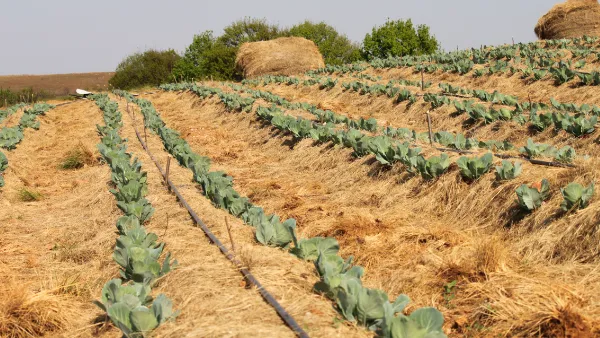
How Do You Choose the Right Dripline Spacing for Your Crops or Garden?
Choosing the correct dripline spacing is one of the most important steps when planning an efficient irrigation system. The spacing between emitters directly affects how evenly water is distributed, how deep it penetrates the soil, and ultimately, how healthy your plants grow.
Whether you’re irrigating a commercial field or a mixed crop garden at home, the goal is the same — consistent, efficient water delivery that reaches the root zone without waste.
NB! The spacing between your emitters is almost always determined by the spacing between your plants as provided to you by the seedling supplier. If you need an average, 30cm is a spacing that works for the majority of crop spacings.
What Is Dripline Spacing?
Dripline spacing refers to the distance between the built-in emitters along the pipe. This distance controls how often water is released along each row.
- Closer spacing (20-40 cm): Used for crops with shallow roots or tightly spaced plants like lettuce, onions, or spinach.
- Wider spacing (50-120 cm): Suitable for crops with larger root zones such as tomatoes, peppers, maize, or fruit trees.
When spacing is chosen correctly, water from each emitter overlaps slightly with the next, forming a continuous wetting pattern along the root zone.
How to Choose the Right Spacing for Your Crop
1. Look at Your Crop’s Root Depth
Plants with shallow roots (like leafy greens) need emitters closer together to keep the upper soil moist. Deeper-rooted plants (like tomatoes or trees) can handle wider spacing as water travels deeper through the soil profile.
2. Consider Your Soil Type
- Sandy soils: Drain quickly — choose closer emitter spacing to prevent dry gaps.
- Loamy soils: Retain water well — medium spacing (around 30 cm) usually works perfectly.
- Clay soils: Spread water more widely — wider spacing may still give good coverage.
3. Think About Crop Layout
If your garden or field contains mixed crops, uniform spacing simplifies installation and ensures all plants receive sufficient water without overcomplicating the layout.
Afriq Water’s Recommendation for Mixed Crops
At Afriq Water, we’ve worked with farms and gardeners across South Africa — and for most mixed crop layouts, a 30 cm emitter spacing is the most practical and effective choice.
- It suits a wide variety of crops — from vegetables and herbs to small fruit plants.
- It provides excellent overlap and root-zone coverage in most soil types.
- It’s the most widely available configuration, making replacements and extensions simple.
Final Thoughts
Emitter spacing is the quiet hero of drip irrigation design. Get it right, and your system will deliver consistent results for years. For most gardens and mixed crop farms in South Africa, 30 cm spacing provides the best balance between performance, practicality, and cost.
Afriq Drip dripline is proudly manufactured in South Africa and available in standard 30 cm spacing — with other configurations available on request for specialised applications.
Where to Find Dripline Irrigation in South Africa
Our Afriq Drip range is proudly manufactured in South Africa, offering reliable, value-for-money irrigation solutions for farms of all sizes.
You can find our dripline rolls and fittings at most agricultural Co-Ops and irrigation suppliers across the country. Stock availability may vary, as we manufacture to order, so please allow 2–3 weeks lead time.
Prefer to buy online? Visit:
www.irrigationonlinesa.co.za
Or contact our distributor to find your nearest retailer:
www.iunlimited.co.za/contact/
